You’ve tried a chore chart before. It worked for a week. Then life got busy, and the chart ended up in a drawer.
Sound familiar?
Most parents think the chart is the problem. It’s not. The real issue is how the chart gets used.
This post gives you 10 free printable chore charts for kids, sorted by age from toddlers to teens. Every chart is a free PDF. You can print, laminate, and reuse them all year long.
But more than that, you’ll also get a clear plan to make the charts actually work. No more nagging. No more reminders every five minutes. Just kids who know what to do and do it.
Why Chore Charts Work (and Why They Often Don’t)
Chore charts do more than keep the house clean. They teach kids real-life skills.
According to the American Academy of Pediatrics, kids who do regular chores build more confidence. They also handle frustration better than kids who don’t.
The Harvard Grant Study found that children who did chores grew up to be more successful adults.
Here’s what a good chore chart does for your family:
- Stops the nagging. The chart tells your child what to do. You don’t have to.
- Sets clear expectations. Kids know exactly what is expected of them each day.
- Builds responsibility. Finishing tasks gives kids a sense of achievement.
- Teaches time management. Kids learn to plan and complete tasks independently.
Why Do Chore Charts Stop Working?
Most chore charts fail. Here’s why:
- The chart is too complicated. Too many chores, too many columns, too much to track.
- There’s no reward or consequence. Kids lose interest fast without a reason to keep going.
- Parents stop checking in. If you forget, your child will too.
- The chart isn’t visible. Out of sight means out of mind.
- The chores don’t match the child’s age. If a task is too hard or too easy, kids give up or get bored.
The good news? All of these problems are easy to fix. The sections below show you exactly how.
How to Choose the Right Chore Chart for Your Kid’s Age
Not every chart works for every child. The right chart depends on your child’s age.
Here’s a quick guide to help you pick the best one:
Toddlers (Ages 2–3)
- Use picture-based charts. They can’t read yet.
- Stick to 3–4 tasks only.
- Examples: pick up toys, put shoes away.
Preschoolers (Ages 4–5)
- Use simple daily checklists with large text and pictures.
- 4–5 tasks work best.
- Examples: make the bed, clear their plate.
Early Elementary (Ages 6–9)
- Use a weekly checklist with days of the week.
- 5–7 tasks are a good range.
- You can start adding rotating chores here.
Tweens (Ages 10–12)
- Use a detailed weekly chart with daily and weekly task sections.
- 6–8 tasks work well.
- They can start taking on bigger responsibilities.
Teens (Ages 13+)
- Use a simple checklist or planner-style chart.
- Focus on independence. Let them track their own progress.
- 5–8 tasks are enough.
The key rule is simple. Match the chart to the child. A chart that fits their age is one they will actually use.
10 Free Printable Chore Charts for Kids
Here are 10 free printable chore charts for kids. Each one is a PDF you can download and print at home. They all work on standard paper and are easy to laminate for reuse.
Chart 1: Visual Picture Chore Chart for Toddlers (Ages 2–3)
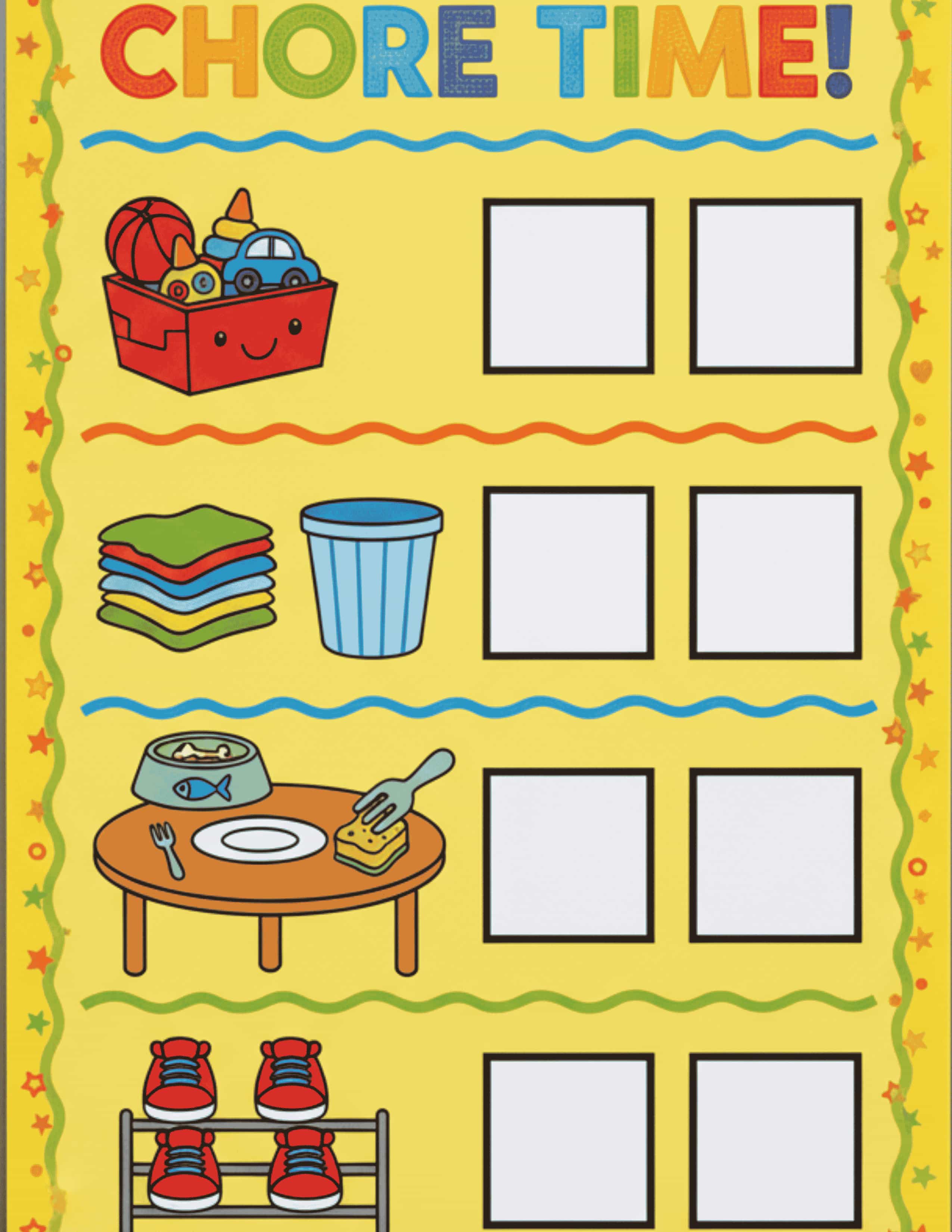
This chart uses images instead of words. Toddlers can’t read yet, but they can follow pictures.
Chart 2: Daily Routine + Chore Chart for Preschoolers (Ages 4–5)
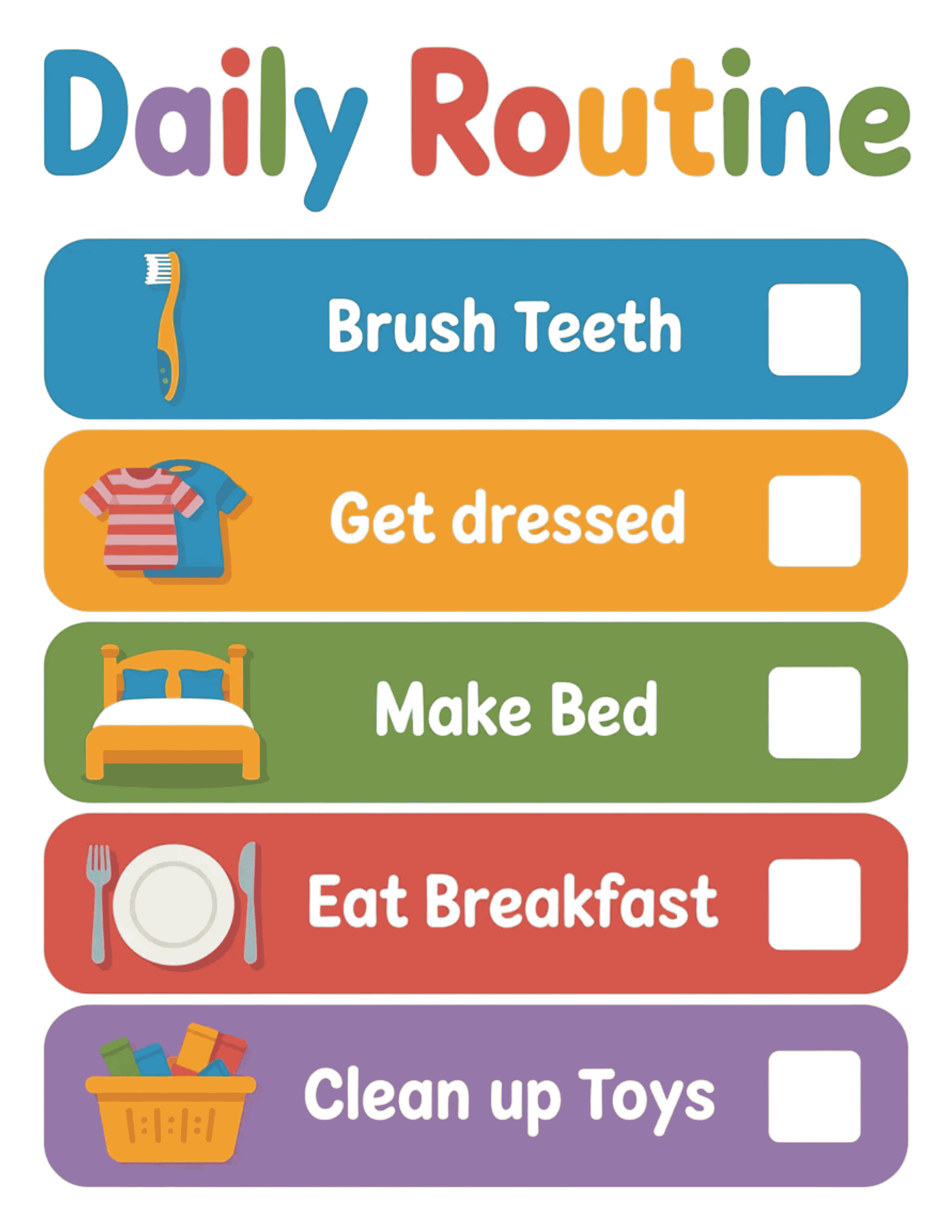
This chart combines the morning routine with simple daily chores. It uses large text and small icons so young readers can follow along.
Chart 3: Weekly Chore Checklist for Early Elementary (Ages 6–7)
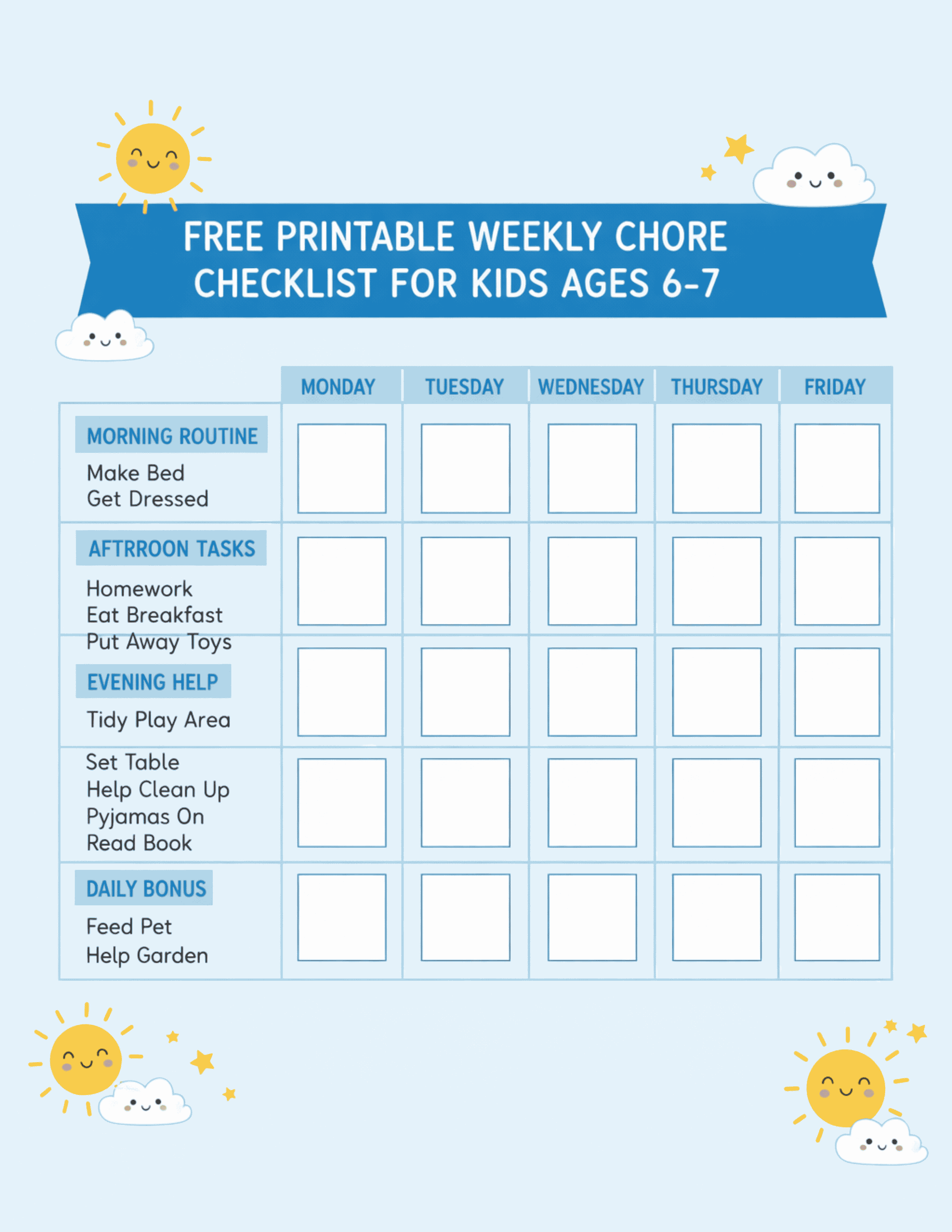
A classic Monday through Friday grid. Parents fill in the chores. Kids check off each task as they finish.
Chart 4: Rotating Chore Chart for Older Elementary (Ages 8–9)
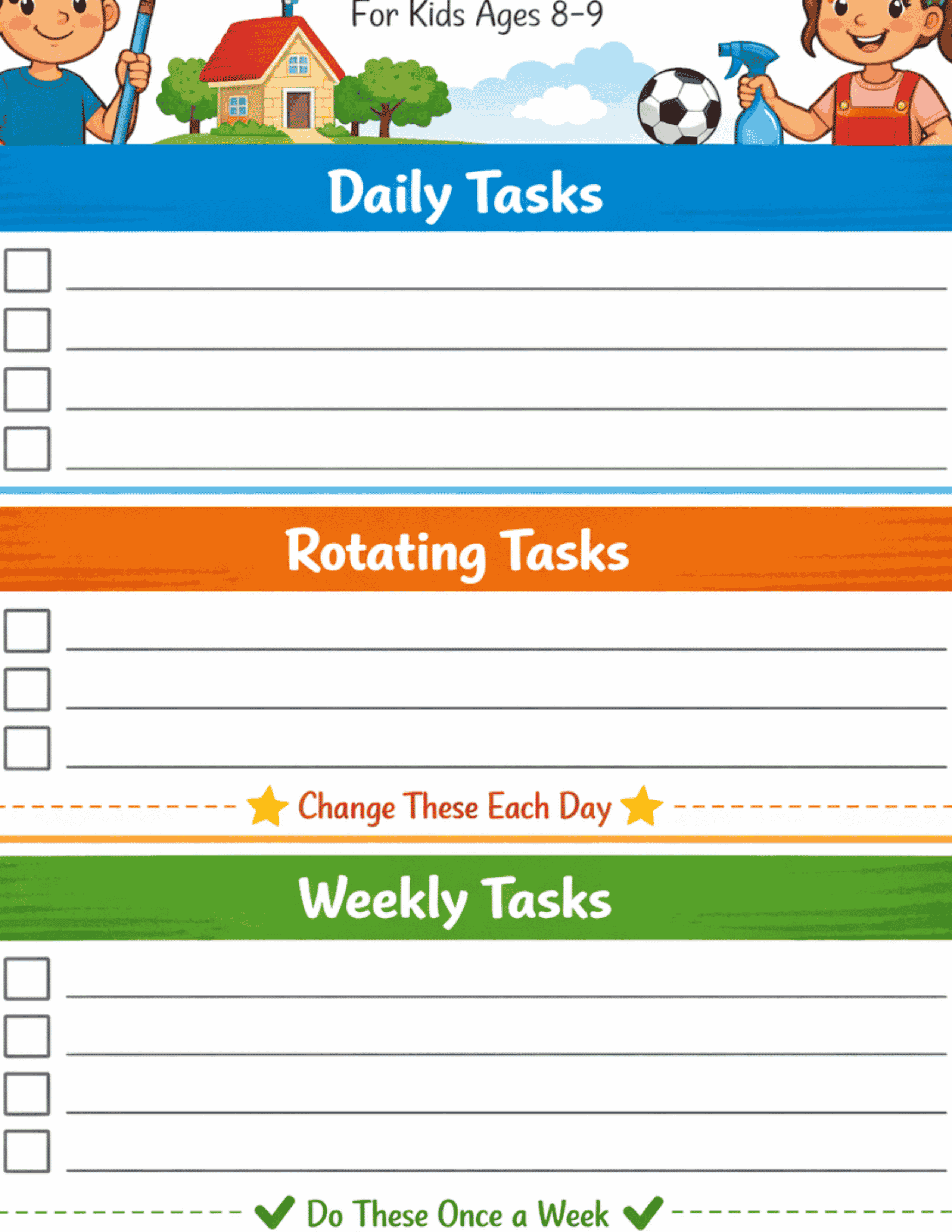
This chart includes daily tasks plus rotating tasks that change each day. It keeps things fresh and stops kids from getting bored with the same chores.
Chart 5: Chore Chart for Tweens (Ages 10–12)
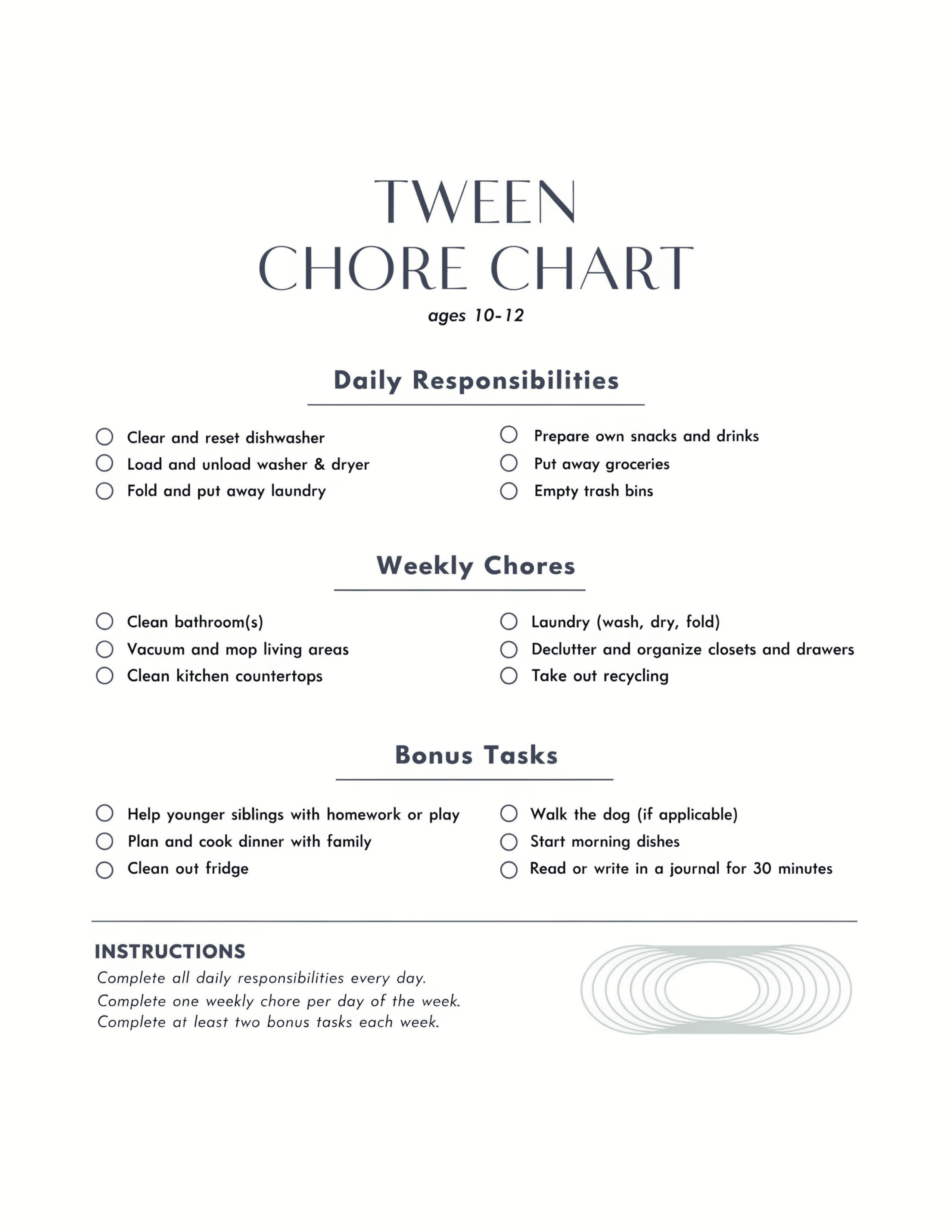
A more grown-up design with no cartoons. This chart has three clear sections so tweens can manage bigger responsibilities.
Chart 6: Teen Chore Checklist (Ages 13+)
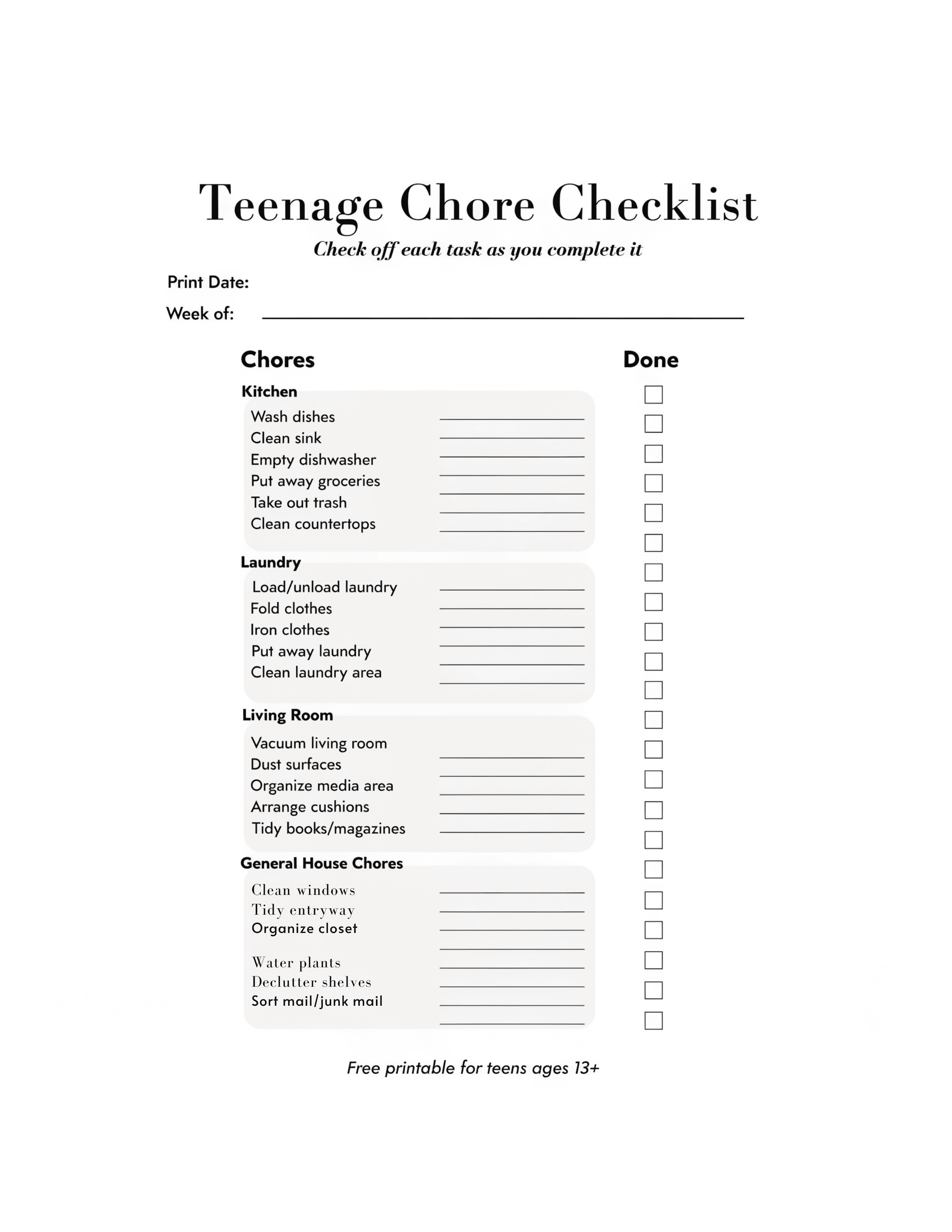
A clean, planner-style chart built for teens. It respects their independence and lets them track their own progress.
Chart 7: Chore Chart for Multiple Kids
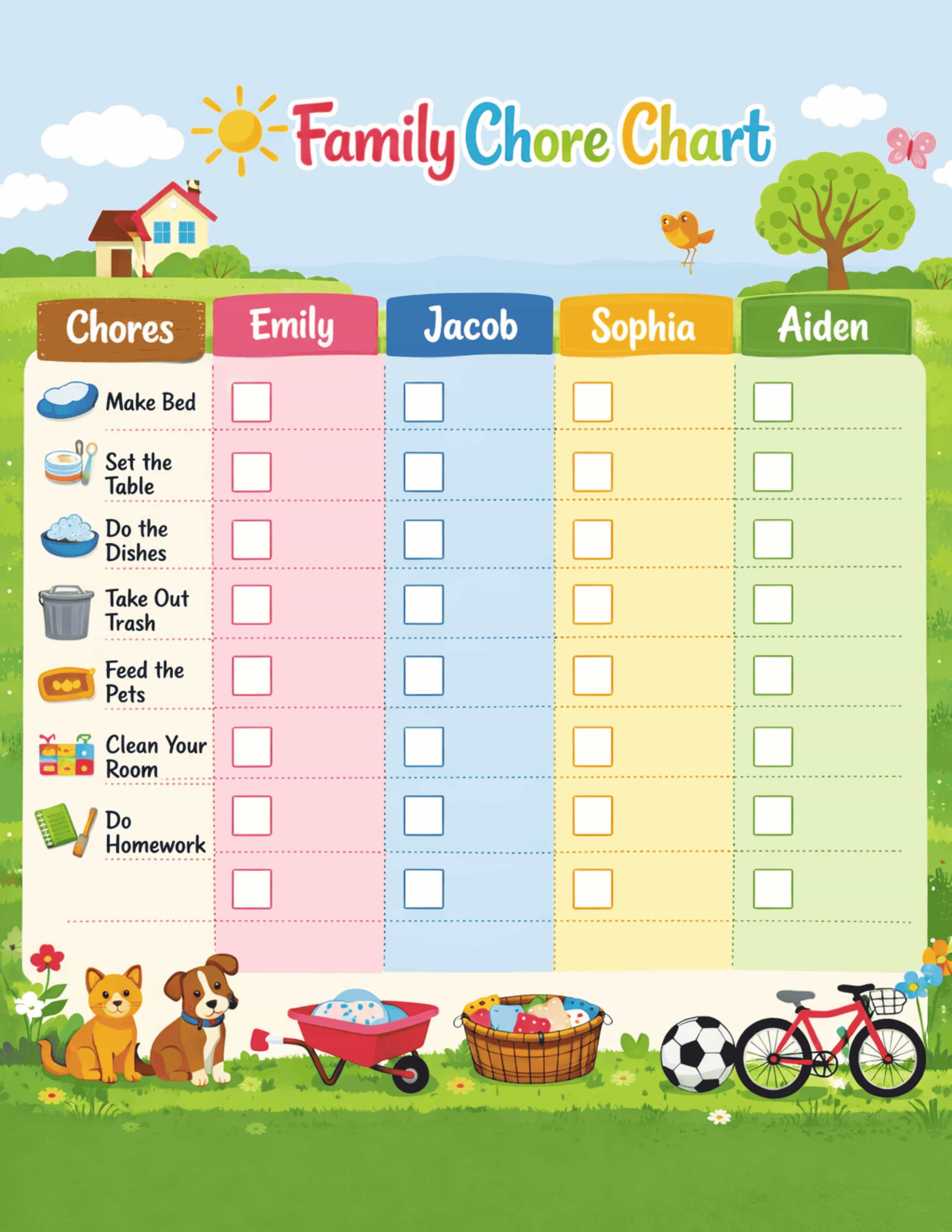
Got more than one child? This chart shows every child’s tasks side by side. No confusion about who does what.
Chart 8: Chore Chart with Reward and Point System
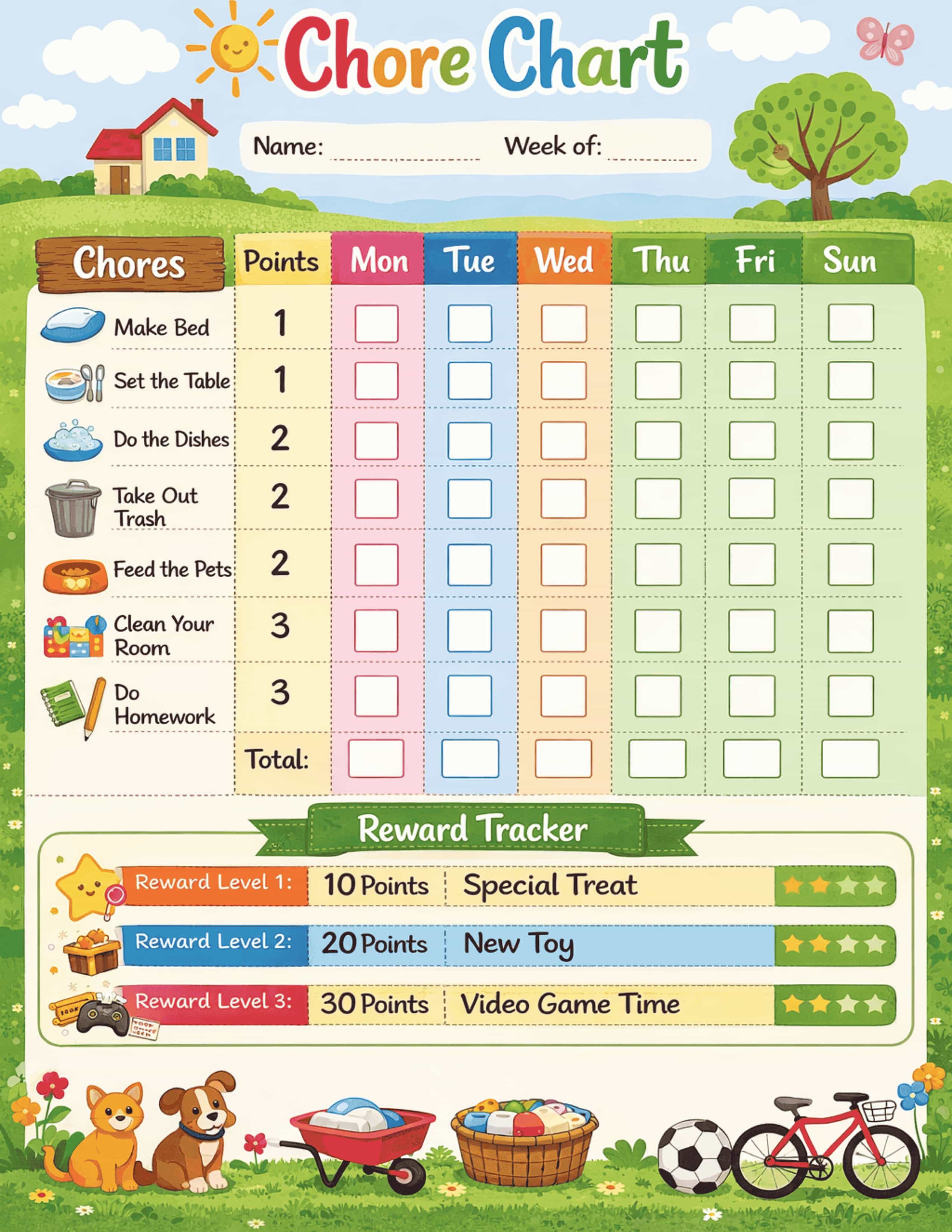
This chart has a points column next to each chore. Kids earn points for every task they finish. Points add up to real rewards.
Chart 9: Editable and Fillable Chore Chart
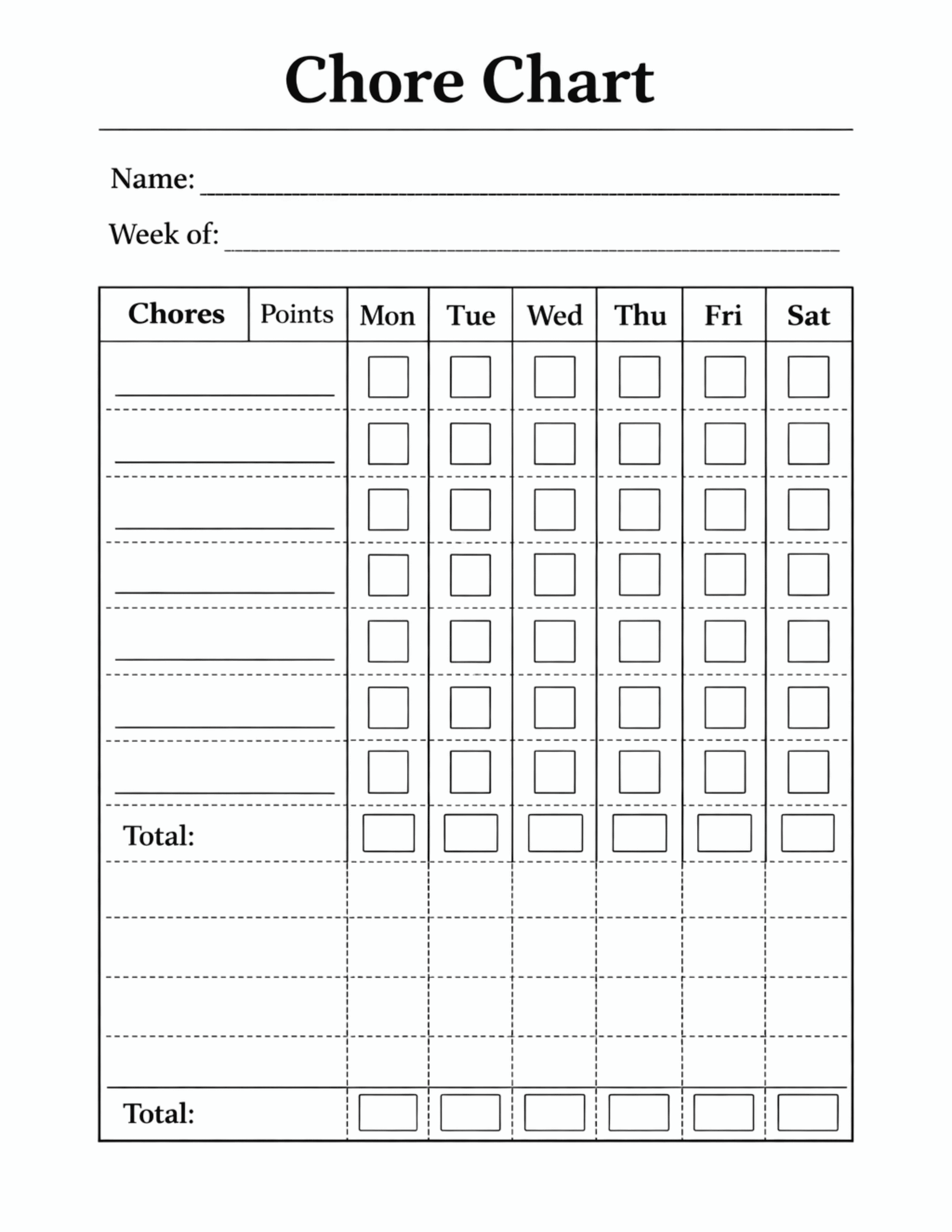
Want to type in your child’s name and chores before printing? This is the chart for you. Clean and simple design with fillable fields.
Chart 10: Summer Chore Chart for Kids
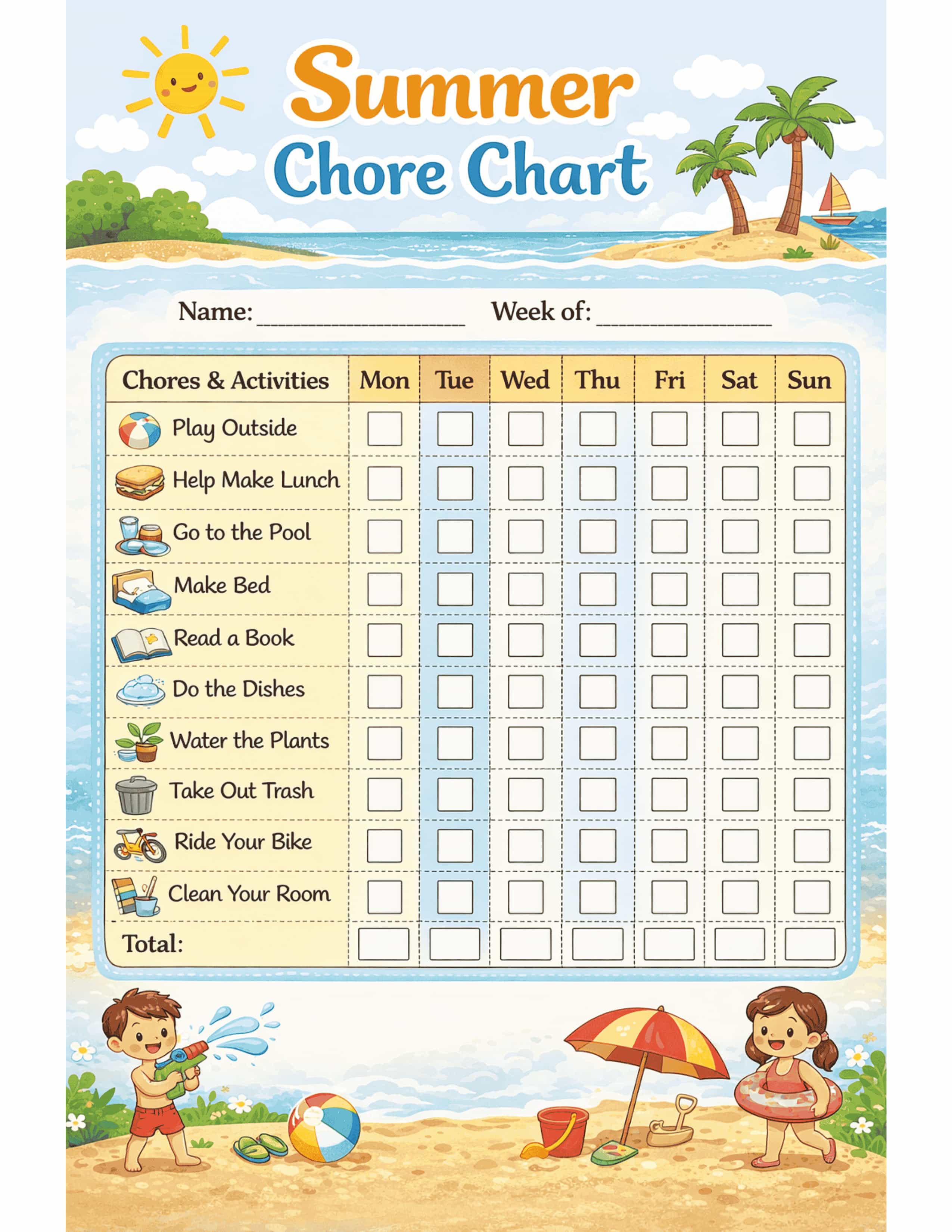
Summer days can get long without structure. This chart mixes fun summer activities with household chores to keep kids on track.
Age-Appropriate Chores: What to Put on the Chart
Picking the right chores for your child’s age is important. Chores that are too hard cause frustration. Chores that are too easy cause boredom. Here’s a clear breakdown by age.
| Age Group | Chores |
|---|---|
| Ages 2–3 (Toddlers) | Pick up toys and put them in bins · Put dirty clothes in the hamper · Help feed pets with pre-portioned food · Wipe the table with a damp cloth · Put shoes by the door · Help set the table with napkins and plastic cups. |
| Ages 4–5 (Preschoolers) | Everything above, plus: Make their bed · Get dressed on their own · Clear their plate after meals · Water plants with a small can · Help sort laundry by color · Dust low surfaces |
| Ages 6–7 (Early Elementary) | Everything above, plus: Sweep floors · Help load and unload the dishwasher (no sharp items) · Fold simple laundry · Take out small trash cans · Tidy their room · Help with meal prep |
| Ages 8–9 (Older Elementary) | Everything above, plus: Vacuum floors · Wipe down bathroom counters and mirrors · Help with cooking (supervised) · Bring in the mail · Organize backpack and school supplies · Load the washing machine with guidance |
| Ages 10–12 (Tweens) | Everything above, plus: Do laundry start to finish · Clean the bathroom · Mow the lawn with supervision · Prepare simple meals · Watch younger siblings for short periods · Manage their own homework and schedule |
| Ages 13+ (Teens) | Everything above, plus: Deep clean the kitchen · Babysit younger siblings · Grocery shop from a list · Handle basic home maintenance · Manage their own full laundry cycle · Plan and cook a full family meal. |
Pro Tip: Start with fewer chores than you think your child can handle. It’s easier to add more chores later than to deal with a burned-out kid in week one.
How to Make a Chore Chart Actually Stick
Downloading a chart is the easy part. Getting your kids to use it every day is the real challenge. Here are 5 tips that make a real difference.
Tip 1: Start with Fewer Chores Than You Think
More chores on the chart does not mean more gets done. It usually means nothing gets done.
- Give toddlers and preschoolers just 3–4 chores
- Give elementary-aged kids 5–6 chores
- Give tweens and teens 6–8 chores
A short list feels manageable. A long list feels overwhelming. Start small and add more chores only when your child is ready.
Tip 2: Put the Chart at Your Child’s Eye Level
If your child can’t see the chart, they will forget it exists.
Here are some good spots:
- On the fridge at kid height
- On a bulletin board in their room
- Taped inside their closet door
The chart should be somewhere your child looks every day. They should be able to check it without you pointing to it.
Tip 3: Be Consistent for the First Two Weeks
The first two weeks make or break the habit.
- Check in at the same time every day
- After school or before dinner works well for most families
- If you forget to check in, your child will forget to use the chart
You don’t need to be strict. You need to be consistent. Two weeks of daily check-ins are usually enough to build the habit.
Tip 4: Let Your Child Pick Some of Their Chores
Kids are more likely to do chores they helped choose.
Here’s how to do it:
- Write out a list of 8–10 chores that need to get done
- Let your child pick 5 from the list
- Put those 5 chores on the chart
This gives your child a sense of control. And kids who feel in control are far more likely to follow through.
Tip 5: Laminate the Chart and Use Dry-Erase Markers
Print the chart once. Use it all year.
Here’s what you need:
- Self-adhesive laminating sheets
- Fine-tip dry-erase markers
- Adhesive magnets to stick it to the fridge
Your child checks off each chore with a dry-erase marker. At the end of the week, wipe it clean and start again. No printing a new chart every week. No wasted paper.
Chores and Allowance: Should You Pay Kids for Chores?
This is one of the biggest questions parents ask. And honestly, there’s no single right answer. Here’s a fair look at both sides.
The Case for Paying Kids for Chores
Some parents tie chores directly to allowance. Here’s why that can work:
- It teaches kids the value of money
- It builds a strong work ethic from a young age
- It shows kids that effort leads to reward
- It gives them a reason to stay motivated week after week
For some families, this approach works really well. Kids stay engaged because they have a clear goal to work toward.
The Case Against Paying Kids for Chores
Many child experts prefer keeping chores and allowance separate. Here’s their reasoning:
- Chores are part of being a family member. They are not a job.
- When chores are tied to money, kids may refuse to do them if they don’t need the money that week.
- It can send the wrong message that helping at home is optional.
Many child psychologists suggest giving allowance separately from chores. This way, kids learn money management skills without connecting them to household responsibility.
The Middle Ground (Most Practical for Families)
Most families find that a mix of both approaches works best.
Here’s how it works:
Base chores (no pay): These are the chores every family member is expected to do.
- Make their bed
- Clear their plate
- Tidy their room
- Keep up with homework
Extra chores (earn money): These are optional tasks above and beyond the basics.
- Wash the car: $3
- Clean out the garage: $5
- Deep clean the bathroom: $2
Allowance (separate from chores): Give a set weekly allowance to teach money management. A simple rule many families use is $1 per year of age per week.
This approach teaches two things at once. Base chores build responsibility. Extra chores build an understanding of earning. And a separate allowance teaches kids how to save and spend wisely.
Pro Tip: If you use the reward chart (Chart 8), you can track extra chore points separately from base chore points. This makes it easy to see who has earned what by the end of the week.
Non-Monetary Reward Ideas That Actually Motivate Kids
Money is not the only way to reward kids for doing their chores. In fact, for younger children, non-monetary rewards often work better. Here’s a menu of reward ideas sorted by age group.
Toddlers and Preschoolers (Ages 2–5)
Keep rewards simple and immediate. Young kids can’t wait long for a payoff.
- Sticker chart: Every completed chore earns a sticker. Fill a row and earn a small prize.
- Special time with a parent: 15 extra minutes of playtime with mom or dad.
- You pick the bedtime story: Let them choose two books instead of one.
- Praise and a high five: At this age, your approval means everything to them.
Elementary Kids (Ages 6–9)
Kids this age respond well to rewards they can see building up over time.
- Prize box: Fill a box with small dollar store items. Earn a pick after a full week of completed chores.
- Extra screen time: Earn 15-minute increments for each completed day.
- Choose the family movie: Let them pick what everyone watches on Friday night.
- Friend sleepover: Earn a sleepover after a set number of weeks with a full chart.
Tweens (Ages 10–12)
Tweens want rewards that feel more grown-up. Give them options that match their maturity.
- Later bedtime on weekends: A small but meaningful privilege for this age group.
- Choose dinner for the family: Let them pick the meal or the restaurant.
- Earn toward a bigger goal: Set a target like a new game or a fun outing. Track progress on the chart.
- Extra device time: Earn additional phone or tablet time in set increments.
Teens (Ages 13+)
Teens respond best to rewards that give them more freedom and independence.
- Extended curfew: Earn an extra 30 minutes on weekend nights.
- Choose a family activity: Let them plan a day out for the whole family.
- Gas money: A practical reward that feels real and useful to them.
- Earn toward a larger purchase: Set a savings goal together and track contributions from extra chores.
Pro Tip: The best reward is one your child actually wants. Ask them what they’d work toward. You might be surprised by their answers.
Download PDF
Start Using a Printable Chore Chart for Kids This Week
Chore charts work. But only when they are set up the right way.
You now have 10 free printable chore charts for kids, covering ages from toddlers to teens. You have a family chart for multiple kids, a reward chart with a built-in point system, a fillable chart you can type into, and even a summer chart to keep kids on track during the break.
But remember, the chart is only half the equation. The tips in this post are what make it stick. Start small. Put the chart where your child can see it. Check in every day for the first two weeks. Let your child have a say in their chores. And laminate that chart so it lasts all year.
Pick one chart that fits your child’s age. Print it today. Put it up this week. That one small step can make a big difference in how your home runs every day.
Have you ever tried a chore chart with your kids? What worked and what didn’t? Share your experience in the comments below, we’d love to hear from you!